Marketing That Convinces CFOs
How a shared metrics framework transforms marketing from cost center to value driver.
 |
Author: Raul Sfat Date: 11.12.2025 Reading time: 5min |
Marketing loses budgets not because of poor performance but because of the wrong metrics. Those who argue in terms of pipeline, revenue and customer value win.
The situation will be familiar to many companies: Marketing presents rising brand awareness, growing website traffic and successful campaigns. Later in the meeting, the finance department reports declining revenues and weak results. The question from the C-suite: How can marketing perform so well when the business is struggling?
The answer is uncomfortable. Marketing is speaking the wrong language. While finance thinks in terms of revenue, contribution margin and profit margin, marketing argues with metrics that financial thinking considers "nice to have." They show no clear connection to enterprise value. The result: Marketing is treated as a cost center that gets cut first when pressure mounts.
The data shows: This perception is not only wrong – it's risky. Companies with a clearly defined marketing leadership role grow 2.3 times faster¹. Leading marketing organizations increase their enterprise value by 79%². The problem isn't marketing itself. It's the missing translation into the language of finance.
70% of CEOs measure marketing impact by revenue growth, new customer acquisition and pipeline development. Only 35% of marketing leaders track this as a top metric¹. This gap reveals the central problem: Marketing and finance live in parallel realities. An effective B2B marketing strategy must close this gap from the outset. Finance expects answers to questions like "How does this spend contribute to revenue?" Or: "What ROI do we generate per euro invested?" Marketing delivers visibility numbers and MQL growth instead.
Only 30% of marketing leaders believe there is a clearly defined view of marketing ROI¹. At the same time, marketing budgets are declining to 7.7% of revenue (down from 9.1%). 80% of CEOs and 77% of marketing leaders consider marketing underfunded. This gap emerges because finance often perceives marketing as a cost center rather than an investment. Meanwhile, continuous budget cuts lead to worse long-term results in revenue growth and market share.
The fragmentation of customer journey ownership makes the problem worse. With digital sales channels, e-commerce and new responsibilities at the customer interface, it becomes unclear who is actually responsible for the customer. When everyone is responsible for growth, no one is³.
What top performers do differently
(Source: PwC 2025²)
Acht Länder, acht unterschiedliche Marketing-Prozesse – vor dieser Situation steht Manpower. Die Folge: Uneinigkeit darüber, welche Leads Priorität haben, sowie erschwertes Benchmarking und Austausch über Best Practices.
Um internationale Vergleichbarkeit zu schaffen und Lernprozesse im Unternehmen anzuregen, will das nordeuropäische Marketing-Team um Projektleiterin Tina Hingston ein länderübergreifend konsistentes Lead Scoring und Reporting einführen. Dafür holt sie sich Unterstützung des Strategiepartners andweekly.
Von der herausfordernden und zeitaufwendigen Rekrutierung geeigneter Fachkräfte sind Unternehmen in vielen Branchen und Regionen betroffen. Das Ziel von Manpower ist es, dem Personalmangel weltweit mit innovativen Lösungen zu begegnen. Die ManpowerGroup mit Hauptsitz in den USA und Niederlassungen in rund 80 Ländern zählt zu den weltweit führenden Unternehmen in der Personalbranche.
Kerngeschäft ist die Vermittlung von Fachkräften aus zahlreichen Branchen an Unternehmen, die sich nicht mit zeitaufwendigen Rekrutierungsprozessen beschäftigen wollen. Darüber hinaus hilft Manpower, kurzfristige Personalengpässe zu überbrücken und Produktionsspitzen mit geeigneten Human Resources auf Zeit abzufedern. Zum Unternehmen gehören zahlreiche Tochterunternehmen – darunter auch der IT-Dienstleister Experis, den wir bereits bei seiner Marketing-Strategie unterstützt haben.

Die ManpowerGroup unterhält in jedem Land ein eigenes Marketing-Team, das individuelle Ansätze im Online-Marketing verfolgt. Zwar wurde HubSpot als All-in-one-Plattform für Marketing in den meisten Landesgesellschaften etabliert, doch das HubSpot-Knowhow und der hinterlegte Lead-Management-Prozess sind sehr unterschiedlich.
Das Problem bei Manpower: Die uneinheitlichen Marketing-Prozesse der Landesgesellschaften führen zu inkonsistenter Lead-Qualifizierung: Ein Lead, der in einer Landesgesellschaft als Sales Ready eingestuft wird, kann in einer anderen als Marketing Qualified Lead (MQL) eingestuft werden.
Daraus ergeben sich für Manpower folgende Herausforderungen:
Mangelnde Vergleichbarkeit. Unterschiedliche Definitionen und Prozesse machen es schwierig, die Leistung und Effektivität von Marketing-Aktivitäten zwischen verschiedenen Landesgesellschaften zu vergleichen. Ohne einheitliche Standards können sie Best Practices nicht identifizieren und erfolgreiche Strategien kaum replizieren.
Schwierigkeiten bei Zusammenarbeit und Kommunikation. Inkonsistente Definitionen führen immer wieder zu Missverständnissen und Fehlkommunikation zwischen Marketing- und Vertriebsteams, insbesondere wenn diese länderübergreifend zusammenarbeiten.
Verpasste Verkaufschancen. Unterschiedliche und nicht immer optimale Definitionen von MQLs und SQLs bewirken, dass Mitarbeitende bestimmte Leads unter- oder überschätzen. Falsche Prioritäten in der Lead-Bearbeitung kosten wiederum wertvolle Ressourcen.
Standardisierung der Marketing-Automatisierungsprozesse für eine nahtlose Customer Journey in den verschiedenen Manpower-Landesgesellschaften
Entwicklung homogener Dashboards auf globaler Ebene zur einheitlichen Erfassung, Analyse und Vergleich der Performances von Marketing-Kampagnen
Optimierung der CRM-Strategie durch Implementierung von Best Practices für Lead-Erfassung, -Qualifizierung, -Scoring und Reporting mithilfe des HubSpot Marketing Hub
Erzielung von Effizienzgewinnen durch Reduzierung von Inkonsistenzen zwischen den Landesgesellschaften
Erhöhung der Transparenz zwischen den Landesgesellschaften hinsichtlich Lead-Generierung, Lead-Qualität und Marketing-Performance zur Verbesserung der Entscheidungsfindung und Performance
The value creation cycle shows how Execution → Brand → Profitability → Enterprise Value works and reinforces itself². Leading marketing organizations achieve significantly higher profitability over five years than the average when they activate all three dimensions: execution, brand, profitability. This effect is not theory. It's based on analysis of more than 190 B2B companies over five years.
The foundation is excellent execution: high-quality, high-impact campaigns, precisely delivered. Over time, this builds brand strength – a long-term asset. Strong brands strengthen presence in decision-makers' minds and enable pricing power. An example: A company increased brand awareness by 15% through clearer positioning and consistent campaigns. The result: reduced need for discounting, higher close rates and a visible increase in the marketing profit multiplier (profit / marketing spend) within six months.
The marketing profit multiplier is the central metric. It translates marketing efficiency into financial language. B2B companies with excellent execution show average annual growth in the marketing profit multiplier that significantly exceeds competitors. Companies with strong brand portfolios achieve even higher growth rates.
How B2B companies structure marketing KPIs for finance alignment
(Sources: PwC 2025², McKinsey 2025⁵)
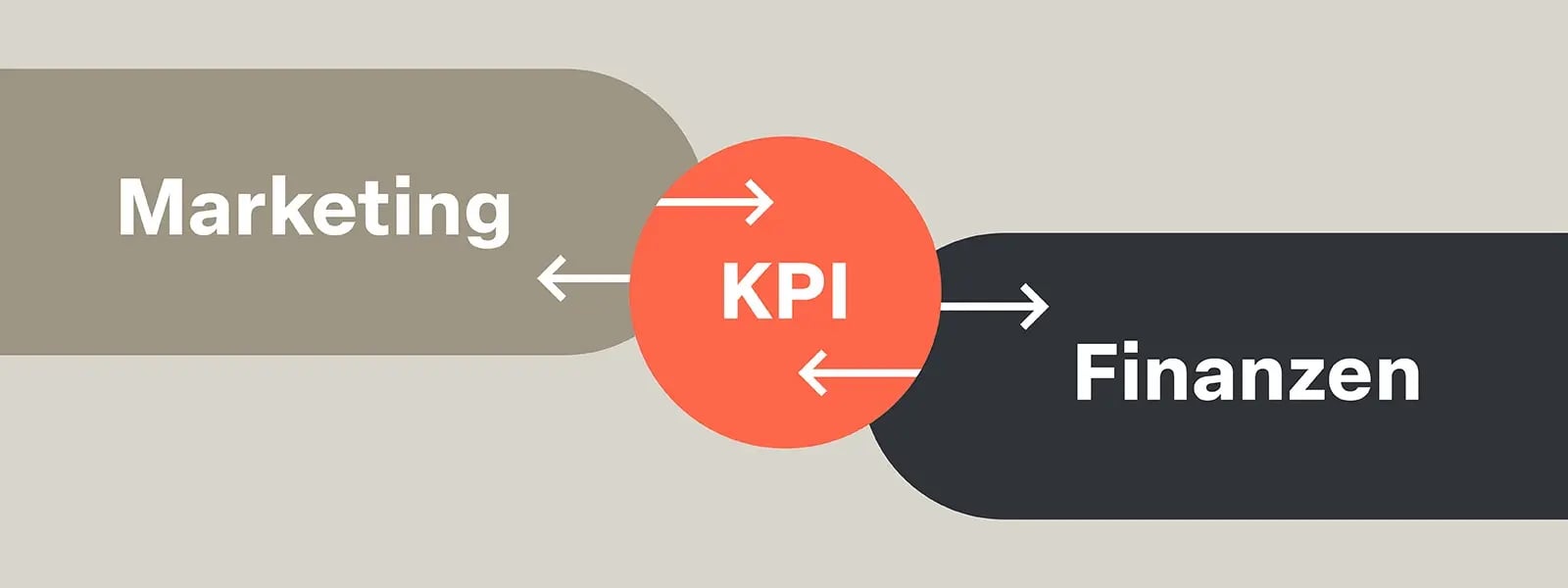
The relationship between marketing and finance is critical for business success but often marked by distrust. Finance sees marketing as opaque; marketing feels misunderstood. Successful partnerships develop a shared metrics framework. Marketing and finance agree on metrics, measurement methods AND their use.
A B2B company developed a shared system with leading indicators together with finance. Example: Brand impulses as a leading indicator for pipeline development. Brand impulses are early signals that more relevant decision-makers are thinking about the brand – visible through rising brand searches, more direct traffic or growing engagement from buying groups. These signals typically rise weeks to months before pipeline becomes visible. Add to that a portfolio allocation system that directly links marketing spend to sales outcomes. The result: measurable revenue increase and growing trust between marketing and finance¹.
The shared metrics framework must translate marketing KPIs into business outcomes. Every marketing metric must trace back to business results so that marketing justifies its place in the profit and loss statement. The C-suite must actively promote alignment between marketing and finance and treat marketing as a strategic growth lever, not just an advertising department.
Best practice shows: Successful marketing-finance partnerships systematically analyze which channels and activities deliver which value contribution. They combine this with brand indicators as the basis for budget decisions. They jointly develop metrics like the marketing profit multiplier that both sides understand and accept. The goal: Marketing investments are evaluated with the same rigor as any other capital allocation.
AI can make marketing 2x more profitable when strategically deployed for effectiveness rather than just efficiency². Typical marketing organizations can unlock 10–30% of total spend through better productivity in direct marketing expenditure (55–80% of budget) and indirect costs (20–45%)⁴.
The freed-up budget MUST be reinvested in high-return areas: digital content, brand building, personalization. Not simply saved. An industry example shows the impact: EUR 48 million in savings (EUR 20 million indirect costs + EUR 28 million direct expenditure) → reinvestment in more effective channels → EUR 70 million performance improvement.
The key point: Technology must act as an amplifier, not a brake⁵. Leading B2B companies deploy AI so that sales and marketing teams become more productive and can focus on value-creating activities. AI handles repetitive tasks, qualifies leads automatically and delivers contextual insights exactly when teams need them.
Why reinvestment is 2x more profitable than pure cost cutting
The marketing profit multiplier (profit / marketing spend) translates marketing efficiency directly into the language of finance. Unlike classic ROI metrics that often focus on individual campaigns in isolation, the marketing profit multiplier shows marketing's overall contribution to business success. It makes visible how much gross profit is generated per marketing euro invested – a metric that finance immediately understands and can compare with other investments.
A successful shared metrics framework emerges through three steps: First, agreement on the metrics themselves (metrics pyramid with max. 7 KPIs). Second, alignment on measurement methods (e.g., systematic channel impact analyses and brand indicators). Third, clarity on how the metrics will be used (e.g., as the basis for budget decisions). What's critical is that both sides can transparently understand the methodology and plan together, rather than marketing justifying retroactively.
In a B2B context, core metrics should include pipeline contribution, customer lifetime value, customer acquisition cost, marketing-generated revenue, share of customer wallet, new customer share of growth (>10%), sales cycle length and close rate. Important: All metrics must contribute to growth strategy and cover both short-term and long-term perspectives. Avoid metrics without business connection, like pure MQL numbers without pipeline linkage.
The value creation cycle is not a linear funnel but a self-reinforcing cycle. Excellent execution builds brand strength, strong brands enable better profit multipliers, and profitability growth creates enterprise value that gets reinvested in new capabilities (like AI). Traditional funnel models end at conversion. The cycle shows how marketing continuously creates enterprise value and finances itself.
Aggressive marketing cuts damage revenue growth, conversion rates and market share over time. The reason: Brand strength builds over years but can erode quickly. Companies that cut marketing in uncertain times lose presence with decision-makers, weaken pricing power and cede ground to competitors. Studies show: Companies that maintain marketing investments during crises gain significantly higher market share when markets recover.
Marketing doesn't win budgets through better visibility campaigns. Marketing wins budgets through alignment with finance, clear value translation and proof that every euro invested creates measurable enterprise value.
The core metrics framework consists of four elements:
The most successful marketing leaders are no longer pure brand managers. They are growth architects. They speak the language of finance, develop shared metrics frameworks with finance and the C-suite, and position marketing as a self-financing growth engine. The result: Companies with leading marketing organizations increase their enterprise value by 79% over five years, proving that marketing is not a cost center but the central value driver for sustainable business growth. For companies, aligning marketing and finance on a shared metrics framework becomes critical – as the foundation for transparent decisions and reliable value contributions.
¹ McKinsey & Company (2025): The CMO's comeback: Aligning the C-suite to drive customer-centric growth
² PwC (2025): Marketing in the AI era: To matter more or cost less?
³ McKinsey & Company (2025): Unlocking growth: The power of CEO, CMO, and CFO alignment
⁴ Boston Consulting Group (2025): For CMOs, the Future Starts with Smarter Spending
⁵ McKinsey & Company (2025): Seven tests for B2B growth